

Discover the advantages of our Pension Scheme, to secure your financial future with ease
Your pension is calculated based on your contribution history and years of service, helping provide financial security throughout retirement.
If you become unable to work due to an illness or accident that is not work-related, you may qualify for an invalidity pension.
As survivors of a pensioner, you are not left out. Eligible survivors may receive a portion of the deceased member’s pension, either as a lump-sum payment or as periodic pension benefits, in accordance with applicable regulations.
As a pensioner, you have the option to continue using our Medical Insurance (RAMA). A contribution equivalent to 7.5% of your monthly pension allows you and your eligible dependents to remain covered under RAMA.
Average Monthly Beneficiaries
Average Monthly Pension Payments
Pension Fund Growth Rate
Find out if you are eligible to contribute, with our comprehensive plan and start contributing today.

You are eligible if you are an employee governed by the General Statutes for Public Service and civil servants governed by special statutes.

Political appointees serving in Rwanda are eligible to participate in the pension scheme, regardless of nationality.

Employees sent from a company abroad to work in Rwanda for the same company are covered by their own pension plan, as long as their assignment lasts no more than twelve (12) months. This is based on international agreements approved by Rwanda.

Employees sent to work for the same company in Rwanda from a company abroad are covered by their home company's pension plan, as long as they work in Rwanda for no more than twelve (12) months. This follows international agreements approved by Rwanda.

Voluntary insurance allows individuals who are not covered by social security laws to join the scheme independently. To do so, they simply need to apply and pay the required contribution rate, which is typically 6% of their fixed salary.
Easily navigate the process of claiming your pension benefits with our step-by-step process.
You must have reached the statutory retirement age (typically 60 years) and fulfilled the minimum contribution period by law.
Provide a valid national Identification card or passport to verify your identity and eligibility for pension benefits.
Provide bank account details registered in your name for benefit payments.
A letter confirming the end of your employment or retirement from your employer.
A valid proof of life certificate number, gotten from IREMBO may be required to confirm that the pensioner is alive.
You must be certified by an authorized medical doctor as having a permanent or long-term disability that prevents you from working.
Provide a valid national ID or passport to verify your identity and eligibility for pension benefits.
Submit your personal bank account details in your name,where your pension payments will be deposited.
Submit a medical report from a recognized health facility, certified by the medical doctor confirming the nature and extent of the disability.
A valid proof of life certificate number, gotten from IREMBO may be required to confirm that the pensioner is alive and for recurring payments.
A document confirming your inability to continue working, such as an employer statement or termination due to medical reasons, may be required
Provide a valid death certificate number issued by IREMBO confirming the death of the deceased pensioner.
Provide a valid national ID or passport to verify your identity and eligibility for pension benefits.
Submit your personal bank account details in your name,where your pension payments will be deposited.
Documents such as a marriage certificate, birth certificate for children, guardian certificate for guardians or legal declaration obtained must be provided to confirm the relationship to the deceased.
Provide the National ID number or RSSB Number of the deceased pensioner, to verify the identity.
For children, still in school, proof must be provided from the respective institutions for confirmation.
Open to individuals who wish to save for retirement voluntarily, including those not covered under mandatory pension schemes.
Provide a valid national ID or passport to register and manage your voluntary pension account.
Set how much you want to contribute monthly. Contribution amount are flexible and can be adjusted over time
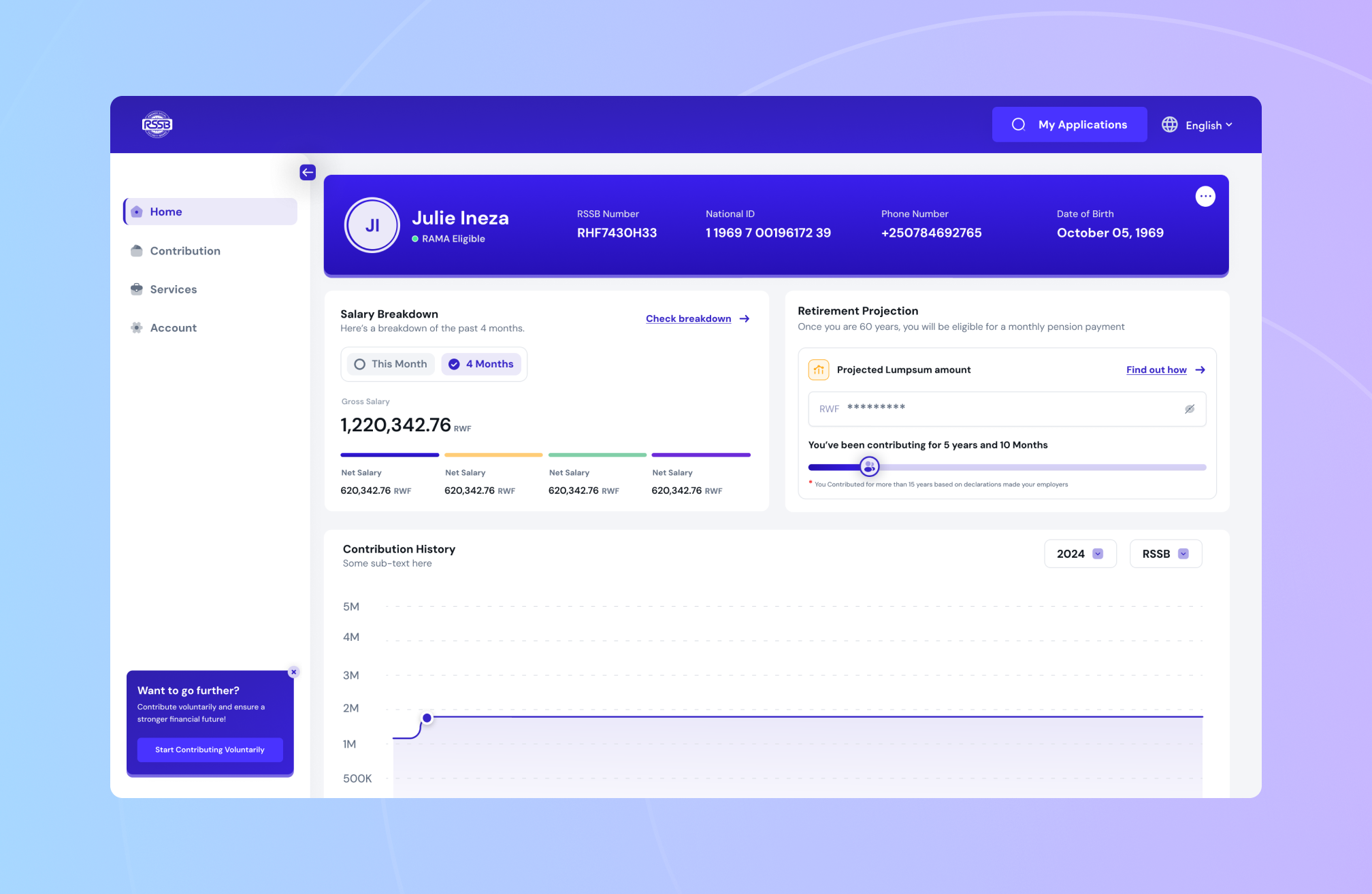
We’ve got the answers you need, with clear and helpful information.
Stay informed with the latest announcements and access publications here.
Explore current opportunities and access active Tenders here


